
Loss Aversion in Marketing: Turning Fear of Loss Into Action
September 11, 2026 | 765 views | 12 min. read time

People hate losing far more than they enjoy winning. Hand someone twenty dollars and they are pleased; take twenty dollars away and they are furious — the pain outweighs the pleasure, even though the amount is identical. That asymmetry is called loss aversion, and understanding it changes how you write offers, design urgency, and recover lost sales. Here is how it works and how to use it without manipulating anyone.
1. What loss aversion is
Loss aversion is the well-documented tendency for losses to feel more powerful than equivalent gains. Research by psychologists Daniel Kahneman and Amos Tversky found that, roughly speaking, the pain of losing something is about twice as intense as the pleasure of gaining the same thing.
That imbalance quietly shapes almost every decision. We hold losing investments too long to avoid locking in a loss, pay for insurance against rare disasters, and feel a withdrawn offer more sharply than we feel an equivalent discount. The prospect of losing is simply a stronger motivator than the prospect of gaining.
For marketers, that means how you frame an offer can matter as much as the offer itself. The same deal, described as something a shopper might lose rather than something they might gain, pulls harder.
2. Why loss aversion drives action
It is worth stressing how large this asymmetry is in practice. Because a loss weighs roughly twice as heavily as the same-sized gain, an offer framed as avoiding a loss can be close to twice as motivating as the identical offer framed as a gain — without changing a single term of the deal. That is an enormous lever for something as simple as a wording choice, and it is why seasoned marketers obsess over whether a message says “save” or “stop losing,” “claim” or “do not miss out.”
A few mechanisms explain why framing around loss is so effective:
- Framing. “Do not miss your 20% off” lands harder than “get 20% off,” because the first version casts the discount as something you already have and could lose, not a bonus you might gain.
- The endowment effect. Once something feels like it is already ours — a reserved item, a trial account, points in a loyalty balance — giving it up feels like a loss, so we work to keep it.
- The cost of inaction. Loss aversion turns waiting into a risk. If an offer or a product might disappear, doing nothing stops being the safe default and starts to feel like a decision with a downside.
In each case the shopper is not weighing a gain against zero; they are weighing action against a potential loss, which is a far more uncomfortable thing to sit with.
3. Loss aversion, FOMO, and urgency
Loss aversion is the engine underneath a lot of familiar tactics. Urgency (“offer ends tonight”) and scarcity (“only 3 left”) are loss aversion made concrete — they define exactly what the shopper stands to lose and when. The fear of missing out, or FOMO, is the social version: the loss on the table is not just a product or a price, but the experience everyone else is about to have without you.
This is why loss aversion and social proof work so well together. Social proof shows that a crowd is enjoying something; loss aversion warns that you are about to be left out of it. One supplies the gain others are getting, the other supplies the sting of missing it.
Used together and honestly, they turn a mild “maybe later” into a much more pressing “I should do this now.”
4. How stores use loss aversion
The practical tactics all share one trait: they make a potential loss visible and specific.
- Low-stock indicators. “Only 3 left in stock” frames hesitation as a risk of missing the item entirely, as long as the number is genuine.
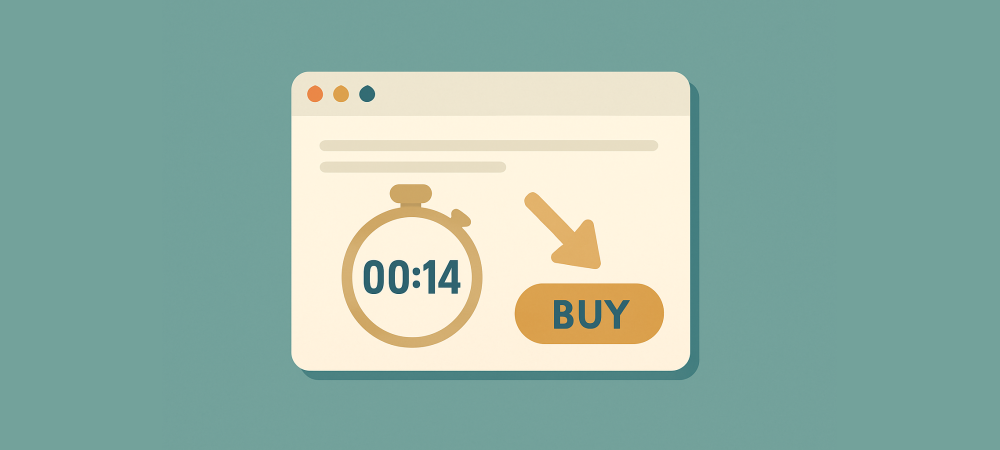
- Countdown timers. A visible deadline on a sale or a shipping cutoff turns an abstract “someday” into a concrete loss at a specific time.
- Free-trial and expiry reminders. “Your trial ends in 2 days” leans on the endowment effect — the account already feels like theirs, so losing it stings.
- Abandoned-cart nudges. Reminding someone that the items they chose are still waiting (and may not be for long) reframes the cart as something they are about to give up.
- Free-shipping thresholds. “You are $5 away from free shipping” makes paying for delivery feel like a loss the shopper can easily avoid.
Notice that none of these invents anything — they simply spell out a real consequence of waiting that the shopper would otherwise overlook.
5. A worked example
Imagine a product page with 5,000 visitors a month converting at 2.2%, for 110 orders. Visitors like the product but many drift away to “think about it,” and most never return. There is no sense that waiting costs them anything.
You add two honest loss-aversion cues: a genuine low-stock indicator on items that really are limited, and a countdown on a time-limited shipping offer. Conversion rises from 2.2% to 2.5%. On 5,000 visitors that is 15 extra orders a month; at a $50 average order value, about $750 in additional monthly revenue — recovered from shoppers who were leaning toward buying but needed a reason not to postpone.
The gain did not come from a bigger discount. It came from making the cost of waiting visible to people who were otherwise happy to wait forever.
6. Using it ethically
There is a business case for honesty here, not just an ethical one. Fake urgency produces a short, one-time bump and then a long tail of damage: shoppers who feel tricked do not come back, leave harsher reviews, and treat your future messages with suspicion. Real urgency, by contrast, compounds — customers learn that when you say an offer is ending it genuinely is, so your deadlines keep their power. In a world where people have seen every fake-countdown trick, being the store whose scarcity is actually real is itself a competitive advantage.
Loss aversion is powerful enough to be abused, and shoppers have grown wise to the abuse. Fake countdowns that reset on refresh, “only 2 left” messages that never change, and invented deadlines are not just off-putting — under tightening consumer-protection rules they can be illegal, and they poison trust in every other message on your site.
The honest version is simple: only signal a loss that is real. If stock is genuinely low, say so; if it is not, do not pretend. If a sale truly ends at midnight, use a countdown; if it will quietly run all week, a timer is a lie. Real urgency respects the shopper by giving them true information to act on; fake urgency treats them as a mark.
Done honestly, loss aversion feels like a helpful heads-up rather than a trick — and that is exactly why it keeps working.
7. Putting loss aversion to work
Start by finding the real losses already present in your store: genuinely limited stock, offers with true deadlines, carts left behind, trials about to expire. These are honest cues waiting to be made visible, not things you need to invent.
Proofly gives you the widgets to surface them — countdown and urgency popups, scarcity and recent-activity notifications — alongside the social proof that pairs so naturally with them. Used on real scarcity and real deadlines, these cues can lift conversions by up to around 15%, by turning a comfortable “later” into a timely “now” without ever misleading the shopper.
Increase conversions for free?
Get started with conversion-boosting social-proof widgets totally free! No creditcard required.
Get started now!Always be up-to-date with Proofly.
The amount of people using your website on mobile devices rapidly increases. Make sure your websites are fully responsive!
59.171%
Mobile devices
This might be useful for you too:
How to Create Urgency on Your Website Without Being Pushy
Urgency sells — but pushy urgency backfires. Fake countdowns and aggressive “buy now or else” tactics might squeeze out a sale, yet they leave visitors feeling manipulated and less likely to retur...
2022-11-22
Read more

Social Proof Glossary: 40+ Terms Explained
Social proof has its own vocabulary — a mix of psychology, marketing, and conversion terms that show up across blogs, tools, and case studies. This glossary defines 40 of the most important ones in plain Engli...
2026-06-02
Read more

Star Ratings and Conversions: What the Data Says
Those little rows of stars next to a product do more heavy lifting than almost any other element on a page. Shoppers scan them in a fraction of a second and use them to decide what to click, what to trust, and what...
2023-08-09
Read more
Ready to use social-proof too?
You can use Proofly within 5 minutes on your own website absolutely free!
Set-up in 5 minutes Over 25,000 satisfied customers No monthly subscription
4.7/5 customer satisfaction
Get started now!
a few thousand others...