
15 Reasons Your Store Gets Traffic But No Sales
September 5, 2023 | 6,856 views | 13 min. read time
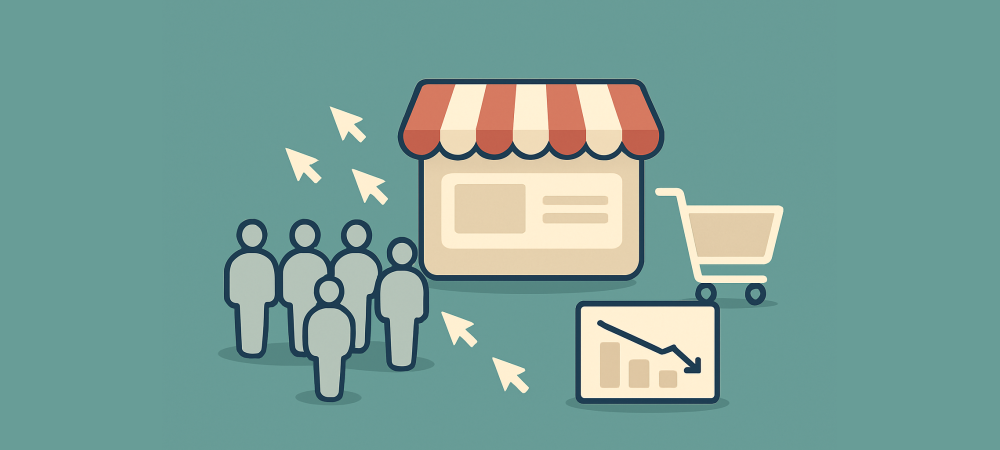
Few things are more frustrating than watching your visitor numbers climb while your sales stay flat. Traffic without sales means something is breaking the journey between arriving and buying — and the good news is that the causes are usually a short list of fixable problems. This guide walks through 15 common reasons a store gets plenty of traffic but no sales, and what to do about each one.
1. Your traffic is the wrong traffic
Not all visitors are potential buyers. If your traffic comes from sources that attract browsers, freebie-seekers, or people outside your market, high numbers will never turn into sales. Before blaming your site, check whether the people arriving actually match who you sell to — the wrong audience is the most common hidden cause of traffic that does not convert.
2. Your value proposition is unclear
Visitors decide in seconds whether a site is worth their time. If they cannot quickly tell what you sell, who it is for, and why it is better, they leave. A vague or cluttered homepage that fails to state a clear, compelling reason to buy quietly turns interested traffic away.
3. Your product pages are weak
The product page is where the sale is won or lost, and thin descriptions or poor images sink it. Shoppers cannot handle the product, so they rely on your copy and visuals to judge it. Vague text, a single small photo, and no answers to obvious questions leave too much doubt to buy.
4. There are no trust signals
A first-time visitor has no reason to trust an unfamiliar store, and nothing on the page to reassure them. Without reviews, security badges, clear contact details, or a professional design, people simply will not risk their money — even if they like the product.
5. You have no social proof
Closely related, an absence of reviews, ratings, or any sign that others have bought makes a store feel untested. Shoppers look for evidence that people like them purchased and were happy; when there is none, they hesitate and leave to find a product that has it.
6. Your prices are a problem
Price objections stop sales quietly. If your prices are noticeably higher than alternatives without a clear reason, or so low they raise suspicion, visitors abandon. Unexpected costs revealed late in the process have the same effect. Make sure your pricing is competitive, justified, and transparent from the start.
7. Shipping costs are too high or hidden
Surprise shipping fees are one of the biggest cart-abandonment triggers there is. A shopper who reaches checkout expecting one price and sees another often leaves for good. Show shipping costs early, and consider free-shipping thresholds, which reliably lift conversion.
8. Your checkout is too complicated
A long, confusing, or multi-step checkout bleeds sales at the final hurdle. Forcing account creation, asking for unnecessary details, or hiding the total all cause people to give up. Streamline the process, offer guest checkout, and remove every step that is not essential.
9. Your site is too slow
Speed is invisible until it is missing. Pages that take several seconds to load lose a large share of visitors before they see anything, and slow product or checkout pages abandon buyers mid-journey. A faster site almost always converts better, so treat performance as a sales issue, not just a technical one.
10. Your site is not mobile-friendly
A huge portion of shopping happens on phones, and a site that is cramped, hard to tap, or awkward to navigate on mobile quietly loses most of that traffic. If your store looks and works well only on a desktop, you are turning away the majority of modern shoppers.
11. Your calls to action are weak
If visitors cannot instantly see what to do next, they do nothing. Buttons that blend into the page, vague labels, or too many competing options create hesitation. One clear, prominent call to action per page gives motivated shoppers an obvious path to purchase.
12. You offer too few payment options
People expect to pay the way they prefer. If you only accept one or two methods and a shopper’s preferred card, wallet, or pay-later option is missing, they abandon at the last step. Offering a range of trusted payment methods removes a needless reason to leave.
13. There is no reason to buy now
Without any gentle urgency, visitors put off the decision — and “later” usually means never. Genuine reasons to act, such as real limited stock, a true deadline, or an expiring offer, help convert people who are interested but drifting. Just keep any urgency honest.
14. Poor navigation hides your products
If people cannot easily find what they want, they cannot buy it. Confusing menus, missing search, or a cluttered layout make shoppers work too hard and give up. Clear categories and a reliable search bar shorten the path from arrival to purchase.
15. You are not addressing objections
Every shopper has doubts — about fit, quality, delivery, or returns. If your pages do not answer those questions, the doubts win. A clear returns policy, an FAQ, visible guarantees, and honest detail remove the friction that quietly sends undecided visitors away.
How to diagnose your own store
Rather than guessing which of these applies, let the data point you to it. Use analytics to find where visitors drop off: high exits on product pages suggest weak pages or missing trust; abandonment at checkout points to friction, cost surprises, or payment gaps. Watching where people leave narrows fifteen possibilities down to the one or two actually costing you sales.
Then fix the biggest leak first and measure the effect before moving on. Adding social proof is often a fast, high-impact starting point — real reviews and live activity, shown where people decide, directly address the trust gap behind many of these problems. Work through the list in order of impact, and the flat sales line starts to climb.
What this looks like in practice
Picture a store running ads that send thousands of visitors to a product page each week, yet sales barely move. The owner assumes the product is the problem. But the analytics tell a different story: most visitors leave the product page within seconds, and of the few who add to cart, nearly all abandon at checkout when a high shipping fee appears.
Two fixes — adding reviews and clear delivery information to the product page, and showing shipping costs upfront with a free-shipping threshold — address the real leaks. The traffic never changed, but the flat sales line finally starts to rise. The point is that traffic without sales is almost always a specific, findable problem, not a hopeless one; the data shows you which of these fifteen reasons is actually yours, so you can fix it rather than guess.
Frequently asked questions
Why am I getting traffic but no sales?
Usually because of a mismatch between visitor and offer, or friction and missing trust on the site — weak product pages, no reviews, a slow or clunky experience, or a complicated, costly checkout. Analytics will show where people drop off.
What is the fastest way to start converting traffic?
Find the biggest drop-off point in your analytics and fix that first. Adding genuine social proof and removing checkout friction are common high-impact quick wins.
Could my traffic itself be the problem?
Yes. If your visitors are not well matched to what you sell, no amount of on-site optimisation will convert them. Check that your traffic sources attract genuine potential buyers.
Conclusion
Traffic without sales is not a mystery — it is a signal that something is breaking the path from visit to purchase. Whether it is the wrong audience, weak product pages, missing trust, a slow site, or a painful checkout, each cause has a clear fix. Use your data to find the biggest leak, address it, measure the result, and keep going. Turn those visitors you already have into buyers, and the numbers finally start to mean something.
Use FOMO on your website!
Install Proofly in a few clicks to take advantage of FOMO on your website today! No creditcard required.
Get started now!Always be up-to-date with Proofly.
The amount of people using your website on mobile devices rapidly increases. Make sure your websites are fully responsive!
55.521%
Mobile devices
This might be useful for you too:
How to Reduce Cart Abandonment: 14 Fixes That Work
Roughly seven out of ten online shopping carts are abandoned before checkout is complete. That is a staggering amount of lost revenue — sales from people who wanted your product enough to add it to their cart...
2023-11-03
Read more
How to Get More Ecommerce Customers
Building an online store is the easy part; getting a steady stream of customers through its virtual doors is the real challenge. With so many stores competing for attention, you need deliberate tactics to attract ne...
2022-01-07
Read more

Social Media Marketing Tips for Small Businesses
For a small business, social media is a rare thing: a marketing channel where effort and creativity can matter more than budget. But it is also easy to pour hours into with little to show for it. The difference come...
2021-10-23
Read more
Ready to use social-proof too?
You can use Proofly within 5 minutes on your own website absolutely free!
Set-up in 5 minutes Over 25,000 satisfied customers No monthly subscription
4.7/5 customer satisfaction
Get started now!
a few thousand others...