
Anchoring Bias: How the First Number Shapes What Shoppers Pay
September 20, 2026 | 711 views | 12 min. read time
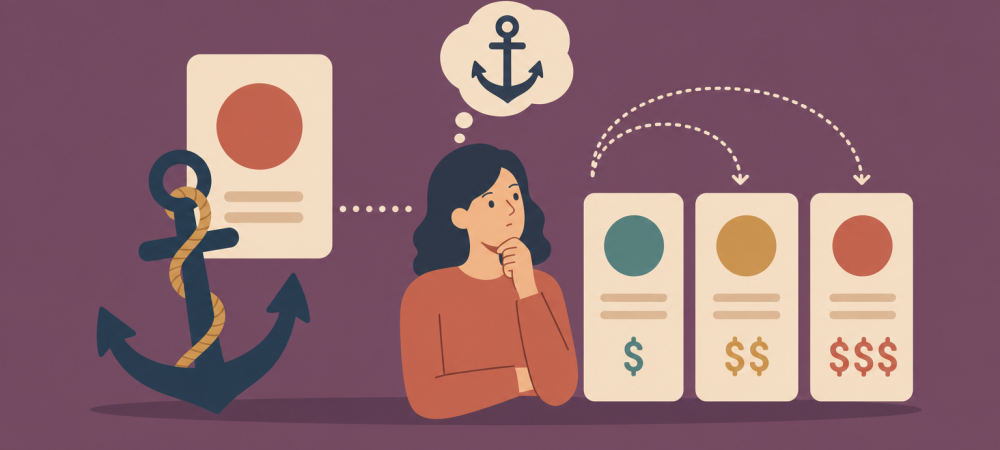
Show someone a high number before they see your price, and your price suddenly feels like a deal. Show a low one, and the same price feels expensive. That is anchoring bias — the first number people see quietly sets the standard they judge everything else against. This guide explains how anchoring works, how stores use it in pricing and social proof, and how to use it without crossing into deception.
1. What anchoring bias is
Anchoring bias is our tendency to rely too heavily on the first piece of information we encounter — the “anchor” — when making a judgement. Once an anchor is set, every later number is measured against it, even when the anchor is arbitrary or irrelevant.
In classic experiments, people asked to estimate a quantity gave far higher answers after seeing a large random number, and far lower ones after a small number, despite the number having nothing to do with the question. The first figure pulls the final judgement toward it, almost regardless of logic.
In a store, the anchor is usually a price — and whoever sets it first shapes what every other price feels like.
2. Why the first number sticks
What makes anchoring so stubborn is that it operates below awareness. People insist they ignored the irrelevant number, yet their estimates drift toward it anyway — and being warned about the bias in advance barely reduces it. For a shopper, that means the reference price or the review count they glimpse first is quietly shaping their sense of fair value even if they would swear it had no effect. You cannot rely on customers to “see through” a weak first impression, which cuts both ways: a poor anchor hurts you just as invisibly as a strong one helps.
Anchoring works because judging value from scratch is hard, so our minds take a shortcut: start from whatever number is already in view and adjust from there. The trouble is that we rarely adjust enough. The anchor keeps a grip on us, and the final judgement lands closer to it than it should.
This is why the order in which people see information matters so much. A $200 item shown next to a $400 one feels reasonable; the same $200 item shown next to a $90 one feels like a splurge. The product is identical — only the anchor changed.
For marketers, that means the first number a shopper sees is not a neutral detail. It is the frame through which they will judge your actual price.
3. Anchoring in pricing
Most pricing tactics are anchoring in disguise:
- Original or compare-at prices. Showing a struck-through “was $80, now $50” anchors shoppers to the $80, so the $50 reads as a saving rather than a cost — as long as the $80 is a real former price.
- Premium options first. Leading with a high-end plan or product sets a high anchor, so the mid option everyone actually buys feels sensible and affordable.
- Bundles and totals. Showing the combined value of a bundle (“$120 of products for $79”) anchors to the $120, making $79 feel generous.
In every case, the same price can feel cheap or expensive depending entirely on the number placed beside it first.
4. Anchoring beyond price: the power of numbers
Anchoring is not only about money. Any prominent number shapes expectations, which is where it overlaps with social proof. A product page that opens with “25,000 happy customers” or “rated 4.8 from 3,000 reviews” anchors the shopper to a large, reassuring figure before they have judged anything else.
That number becomes the lens for everything that follows. A few mixed reviews feel minor against a backdrop of thousands; a mid-range price feels fair for something so clearly popular. The social proof is doing double duty — proving that others trust you, and setting a high anchor of scale and quality.
It works in reverse too: a page with “3 reviews” anchors low, making the product feel unproven no matter how good it is. The lesson is to lead with your strongest genuine numbers, because whichever figure a shopper sees first will colour the rest.
5. A worked example
Notice which lever did the work. The discount itself was not new — the product was always $60 — but without a reference point, $60 floated free, judged against nothing. The $85 anchor gave it meaning, and the review count gave it reassurance. This is why two stores selling the identical item at the identical price can convert at very different rates: the one that frames the number well wins, while the one that shows a bare price leaves the shopper to invent their own anchor, which is rarely flattering to you.
Suppose a product sells for $60 on a page that simply states the price with no context. It converts 2% of 5,000 monthly visitors, for 100 orders.
You reframe the page with two honest anchors: a genuine “regular price $85” struck through above the $60, and a “4.8 from 2,400 reviews” line near the title. Now the $60 reads as a real saving against the $85 anchor, and the large review count anchors quality high before the shopper weighs anything. Conversion rises from 2% to 2.3%. On 5,000 visitors that is 15 extra orders a month; at the $60 price, around $900 in additional monthly revenue — from the same product, simply reframed by the numbers shown first.
No claim here is invented: the former price is real and the reviews are real. The only change is which numbers the shopper meets first.
6. Using anchoring honestly
A simple discipline keeps you safe: every anchor you show should be a number you could defend out loud. If a regulator, a journalist, or a sharp customer asked “was this really the former price?” or “do you really have that many reviews?”, the honest answer should be yes. Anchors that pass that test inform the shopper; anchors that fail it deceive them. Hold to it and anchoring becomes a way of telling the truth more persuasively, rather than a way of bending it.
Anchoring crosses into deception the moment the anchor is fake. A struck-through “original” price the product never actually sold at is a fabricated reference price, and it is exactly the kind of practice consumer-protection regulators now penalise. Inflated review counts or invented customer numbers are the same problem in a different field.
The honest approach is to anchor only with true numbers: real former prices, genuine bundle values, actual review and customer counts. Used that way, anchoring is not a trick — it is simply presenting real information in the order that helps shoppers understand the value. Lead with your strongest truthful figures and let them frame the decision; never manufacture an anchor that does not exist.
7. Putting anchoring to work
Look at your key pages and ask what number a shopper sees first. If it is nothing — just a bare price — you are leaving the frame empty. Lead instead with your strongest honest anchors: a real reference price, a genuine bundle value, and above all your real proof numbers.
Proofly helps with the proof side of the anchor: review and star-rating widgets, customer counts, and recent-activity notifications that put a strong, genuine number in front of shoppers before they judge your price. Anchored to real popularity and real value, your offer can convert up to around 15% better — not because anything was faked, but because the truth was shown in the right order.
Increase conversions for free?
Get started with conversion-boosting social-proof widgets totally free! No creditcard required.
Get started now!Always be up-to-date with Proofly.
The amount of people using your website on mobile devices rapidly increases. Make sure your websites are fully responsive!
59.171%
Mobile devices
This might be useful for you too:
Do Social Proof Popups Slow Down Your Site? A Look at the Real Numbers
Every script you add to your site has a cost, and social proof popups are no exception. The worry is legitimate: does that recent-purchase notification quietly hurt your load time, your Core Web Vitals, and ultimate...
2025-12-07
Read more

Social Proof and the EU Digital Fairness Act: What Changes for Online Stores
The EU has signalled that a Digital Fairness Act is coming, aimed squarely at the manipulative design tricks that have crept into online shopping — including fake urgency, misleading scarcity, and deceptive co...
2026-07-20
Read more
Checkout Page Optimization: 12 Ways to Stop Losing Sales
The checkout page is where sales are won or lost. A shopper who reaches it has already decided they want to buy — so every visitor who abandons here is a sale you were moments away from making. Small problems...
2024-01-28
Read more
Ready to use social-proof too?
You can use Proofly within 5 minutes on your own website absolutely free!
Set-up in 5 minutes Over 25,000 satisfied customers No monthly subscription
4.7/5 customer satisfaction
Get started now!
a few thousand others...