
How to Calculate Your Conversion Rate (And What Good Looks Like)
August 30, 2023 | 7,994 views | 12 min. read time
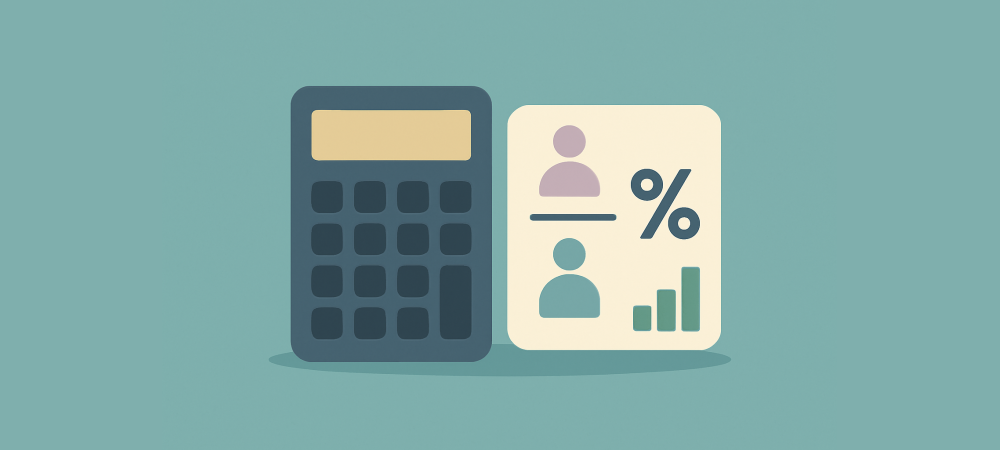
Your conversion rate is one of the most important numbers in your business — it tells you how well your website turns visitors into customers. Yet many store owners either do not track it or are not sure how to calculate it correctly. This guide explains exactly how to work out your conversion rate, what counts as a conversion, what a good rate looks like, and how to start improving the number once you know it.
1. What a conversion rate is
A conversion rate is the percentage of visitors who take the action you want them to take. For an online store that action is usually a purchase, but it can be any goal that matters: a sign-up, a lead form, a download, or a booking. It is the single clearest measure of how effectively your site turns interest into results.
Because it is a percentage rather than a raw count, the conversion rate lets you compare performance fairly across time, pages, and traffic sources, regardless of how many visitors each one had. That makes it the natural yardstick for judging whether a change to your site actually helped.
2. The formula, with examples
The formula is simple: divide the number of conversions by the number of visitors, then multiply by 100 to get a percentage. In other words, conversion rate equals conversions divided by total visitors, times one hundred.
An example makes it concrete. If your store had 10,000 visitors in a month and 250 of them made a purchase, your conversion rate is 250 divided by 10,000, which is 0.025, or 2.5 percent. If a landing page received 4,000 visitors and generated 120 sign-ups, its conversion rate is 120 divided by 4,000, which is 3 percent. The same formula works for any goal — just count the specific action you care about.
3. Different conversions worth tracking
Most businesses have more than one conversion worth measuring. The headline number is usually the overall purchase rate, but breaking it down reveals far more. You might track add-to-cart rate, checkout completion rate, email sign-up rate, and the conversion rate of individual campaigns or landing pages.
These smaller rates act like a diagnostic map. If plenty of people add to cart but few complete checkout, the problem is in your checkout, not your product pages. Tracking conversions at each step shows you exactly where visitors drop off, so you can fix the right thing instead of guessing.
4. What a good conversion rate looks like
This is the question everyone asks, and the honest answer is: it depends. Conversion rates vary widely by industry, product type, price point, and traffic source. Many ecommerce stores sit somewhere in the low single digits, but a high-priced or considered purchase may convert far lower and still be healthy, while a warm email list can convert much higher.
Because of that variation, the most useful benchmark is your own past performance. Rather than obsessing over an industry average that may not fit your situation, focus on steadily improving your own rate over time. A store that lifts its conversion rate from 1.5 to 2 percent has grown its revenue by a third from the same traffic — that trend matters more than any headline figure.
5. Why your conversion rate might be low
A low conversion rate is a symptom, and the causes are usually a handful of familiar culprits. The traffic might be poorly matched to what you sell, so visitors arrive without real intent. The site might be slow, confusing, or awkward on mobile. Trust might be missing — no reviews, no security signals, an unfamiliar brand. Or the checkout might be long, costly, or full of surprises.
The key is not to panic at a low number but to diagnose it. Use your step-by-step conversion rates to find where people leave, then look closely at that stage. Most conversion problems trace back to friction, a lack of trust, or a mismatch between the visitor and the offer.
6. How to improve your conversion rate
Once you know your number and where visitors drop off, improvement follows a clear path. Reduce friction by simplifying navigation, speeding up the site, and streamlining checkout. Build trust with reviews, ratings, testimonials, and clear policies. Make your value and calls to action obvious, and address common objections before they cost you the sale.
Then test your changes rather than assuming. Adjust one thing at a time and compare the conversion rate before and after, so you keep what genuinely helps and discard what does not. Small, verified improvements compound: a series of modest gains adds up to a dramatically better rate over a year.
7. How to measure it accurately
Accurate measurement depends on clean data. Use an analytics tool to track visitors and conversions consistently, and make sure you are counting the right thing — unique visitors rather than raw hits, and genuine conversions rather than test orders or bot traffic. Define each goal clearly so the numbers stay comparable from month to month.
Watch trends over a sensible time frame instead of reacting to daily swings, which are often just noise. A conversion rate is most useful as a line on a chart over weeks and months, showing whether your efforts are steadily moving the number in the right direction.
A worked example, step by step
Suppose you want to understand and improve a single product page. Over a month it received 6,000 visitors and produced 90 sales, so its conversion rate is 90 divided by 6,000, which is 1.5 percent. On its own, that number is just a baseline — the value comes from breaking the journey down.
Of those 6,000 visitors, say 900 added the product to their cart, a 15 percent add-to-cart rate, but only 90 completed the purchase. That means just 10 percent of the people who added to cart actually checked out. Suddenly the problem is obvious: the product page is doing its job of generating interest, but something in the cart or checkout is losing nine out of ten motivated buyers.
Now you know where to focus. Instead of rewriting the product page, you investigate the checkout — unexpected shipping costs, a forced account, too many steps — fix the worst offender, and watch that checkout-completion rate. If it climbs from 10 to 15 percent, your sales rise by half from the very same traffic. This is why calculating conversion rates at each stage, rather than only the headline number, turns a vague sense that sales are low into a precise, fixable diagnosis.
Frequently asked questions
How do I calculate my conversion rate?
Divide the number of conversions by the number of visitors and multiply by 100. For example, 250 purchases from 10,000 visitors is a 2.5 percent conversion rate.
What is a good conversion rate?
It depends heavily on your industry, price point, and traffic. Many stores sit in the low single digits, but the most useful benchmark is improving your own rate over time.
Should I track more than one conversion rate?
Yes. Tracking add-to-cart, checkout, and sign-up rates separately shows exactly where visitors drop off, so you can fix the right stage rather than guessing.
Conclusion
Your conversion rate is a simple calculation — conversions divided by visitors, times one hundred — but it is one of the most revealing numbers you can track. Measure it accurately, break it down by step to find where people leave, and judge yourself against your own trend rather than a generic benchmark. Know the number, act on what it tells you, and every improvement turns the traffic you already have into more sales.
Use FOMO on your website!
Install Proofly in a few clicks to take advantage of FOMO on your website today! No creditcard required.
Get started now!Always be up-to-date with Proofly.
The amount of people using your website on mobile devices rapidly increases. Make sure your websites are fully responsive!
55.521%
Mobile devices
This might be useful for you too:
How to Reduce Cart Abandonment: 14 Fixes That Work
Roughly seven out of ten online shopping carts are abandoned before checkout is complete. That is a staggering amount of lost revenue — sales from people who wanted your product enough to add it to their cart...
2023-11-03
Read more
7 Ways to Get More Leads Without Spending a Fortune
Generating leads does not have to drain your budget. Some of the most effective ways to attract potential customers cost little more than time, creativity, and consistency. Whether you are a small business watching...
2022-02-19
Read more

Social Proof Lifetime Deals: What to Check Before You Buy One
A lifetime deal on a social proof tool sounds almost too good: pay once, use it forever, never see another invoice. Sometimes that is exactly what you get. Other times “lifetime” means the lifetime of th...
2025-09-27
Read more
Ready to use social-proof too?
You can use Proofly within 5 minutes on your own website absolutely free!
Set-up in 5 minutes Over 25,000 satisfied customers No monthly subscription
4.7/5 customer satisfaction
Get started now!
a few thousand others...