
Live Visitor Count: Does Showing Visitors Boost Sales?
September 11, 2024 | 6,162 views | 11 min. read time
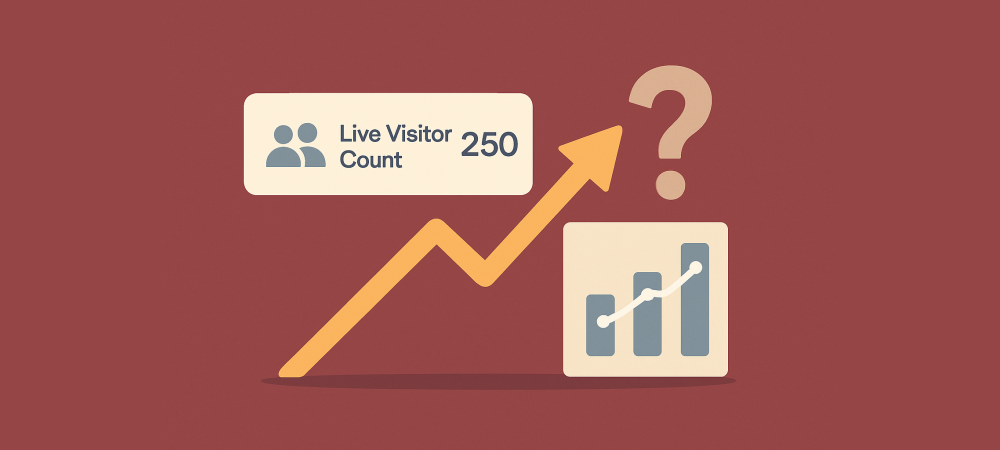
“24 people are viewing this right now.” You have seen the message on countless product pages, but does showing a live visitor count actually boost sales, or is it just decoration? The honest answer is that it can help meaningfully — in the right context, with genuine numbers — but it can also do nothing, or even backfire. This guide looks at the psychology, the evidence, and when a live visitor count is worth using.
1. What a live visitor count is
A live visitor count is a small piece of social proof that shows how many people are currently viewing a page, a product, or your site as a whole. It updates in real time, so it reflects genuine activity happening at that moment rather than a fixed figure. On busy pages, it turns the invisible presence of other shoppers into a visible signal.
The question is not really what it is, but whether it works. To answer that, it helps to understand why a simple number of concurrent viewers might change how someone behaves — and where that effect breaks down.
2. The psychology: why seeing a crowd matters
Humans are deeply influenced by the behaviour of others, especially when unsure. A live visitor count works because it makes that behaviour visible: if many people are looking at a product, our instinct is to assume it must be worth looking at too. This is social proof in one of its purest, most immediate forms.
There is a second effect layered on top. Seeing that others are viewing the same item — potentially competing for the same limited stock — introduces a mild fear of missing out. That gentle urgency can tip a shopper from “maybe later” toward acting now. Together, social proof and urgency are a large part of why live counts can influence decisions at all.
3. So, does it actually boost sales?
In the right situation, yes. When a page has genuine, healthy traffic, a live visitor count reinforces the sense that a product is popular and in demand, which reduces hesitation and nudges more shoppers to buy. It is most effective on high-intent pages — products, bookings, checkout — where a decision is actively being made and a little reassurance or urgency tips the balance.
But the effect is not automatic or universal. A live count only helps when the number is high enough to signal popularity; on a quiet page it can quietly undermine confidence instead. And like any single tactic, it works best as one part of a broader trust strategy rather than a magic switch. Treated realistically, it is a useful lever — not a guaranteed sales boost you can bolt onto any page.
It also helps to be clear about what a live count actually changes. It rarely creates desire that was not already there; instead, it reduces hesitation in shoppers who were already interested, giving them the small extra push to act now rather than later. Understood that way, it is a nudge for the undecided rather than a magnet for new demand — valuable, but only in proportion to how many genuinely interested visitors a page already has.
4. When it helps and when it hurts
The deciding factor is the number itself. “38 people are viewing this” signals a hot product and encourages action. “2 people are viewing this,” or worse, “1 person,” signals the opposite — that the item is unpopular and perhaps not worth the risk. The same widget can help or hurt depending entirely on whether the count flatters or exposes the page.
This is why context matters so much. A live count suits busy stores, popular products, and peak periods, where real activity is high. It is a poor fit for new sites, quiet pages, and slow periods, where honest numbers are low. The mistake many make is switching it on everywhere; the smarter approach is to show it only where genuine activity makes it an asset.
5. How to use a live visitor count well
To get the benefit without the risk, use a live count selectively and honestly. Place it on high-intent pages with real, healthy traffic, near the product or call to action, so it reinforces the decision at the right moment. Keep the display clear and subtle, and set a sensible threshold so the counter only appears when the number is high enough to help.
Combine it with your other proof rather than relying on it alone. A live count sitting alongside genuine reviews, ratings, and recent-purchase activity paints a consistent picture of a popular, trusted store. On its own it is a single nudge; woven into a broader trust strategy, it pulls its weight. Tools like Proofly include a live visitor counter among their widgets, so you can add one — alongside recent-purchase popups and reviews — from a single snippet, and show it only where genuine activity supports it.
6. How to measure the impact yourself
Rather than assume, test it. Add a live visitor count to a busy product page and compare that page’s conversion rate before and after, watching for changes in add-to-cart and purchase rates. Because you can toggle the counter easily, it lends itself well to a simple before-and-after or A/B comparison.
Pay attention to side effects too. If bounce rate rises or the page feels cluttered, the counter may be doing more harm than good. Let your own numbers, not a blog post or a competitor’s example, decide whether a live count earns its place on each page — the right answer varies by store, product, and audience.
7. The honesty rule
Everything above assumes the number is real. A live visitor count only works because shoppers believe it reflects genuine activity, so faking or inflating it is both dishonest and self-defeating. An invented “50 people viewing” on a clearly quiet site is quickly doubted, and once a shopper suspects one number is fake, they distrust every other signal you show. Real numbers build trust; fabricated ones destroy it. Protecting that trust is worth far more than any short-term lift a fake number might buy, because a store caught inflating one figure gives shoppers reason to doubt all the others.
Frequently asked questions
Does a live visitor count really increase sales?
It can, on high-intent pages with genuine, healthy traffic, by combining social proof with gentle urgency. On quiet pages with low numbers it adds little or backfires, so it is not a universal boost.
What is a good number to show?
High enough to signal popularity. Large counts encourage action; very low counts (one or two viewers) suggest unpopularity and can hurt, so only show the counter when real activity is strong.
Is it worth using on a new or small site?
Often not yet. New and quiet sites usually have low concurrent traffic, so honest numbers work against you. Focus on other proof first, and add a live count once your pages are genuinely busy.
Conclusion
Showing a live visitor count can boost sales — but only when the numbers are genuine and high enough to signal real popularity, on pages where a decision is being made. Used selectively and honestly, alongside your other social proof, it adds a useful mix of reassurance and urgency. Used everywhere, or faked, it does nothing or actively harms trust. Show real activity where it helps, measure the effect, and let a live count earn its place.
Increase conversions for free?
Get started with conversion-boosting social-proof widgets totally free! No creditcard required.
Get started now!Always be up-to-date with Proofly.
The amount of people using your website on mobile devices rapidly increases. Make sure your websites are fully responsive!
55.521%
Mobile devices
This might be useful for you too:

Tracking Social Proof in GA4: Events, Goals and Attribution
You added social proof notifications to your site. Are they actually working? Without measurement, you are guessing — and “it feels like it helps” is not a strategy. Google Analytics 4 can tell you...
2026-01-13
Read more
How to Create Urgency on Your Website Without Being Pushy
Urgency sells — but pushy urgency backfires. Fake countdowns and aggressive “buy now or else” tactics might squeeze out a sale, yet they leave visitors feeling manipulated and less likely to retur...
2022-11-22
Read more

Social Credibility: How to Build It Online in 2023
You can have a great product and still be ignored if no one believes you are credible. Social credibility — the sense that a brand or person is trusted, established, and worth taking seriously — is what...
2023-02-05
Read more
Ready to use social-proof too?
You can use Proofly within 5 minutes on your own website absolutely free!
Set-up in 5 minutes Over 25,000 satisfied customers No monthly subscription
4.7/5 customer satisfaction
Get started now!
a few thousand others...