
20 Popup Examples That Convert (and the Trigger Behind Each)
September 25, 2026 | 695 views | 12 min. read time
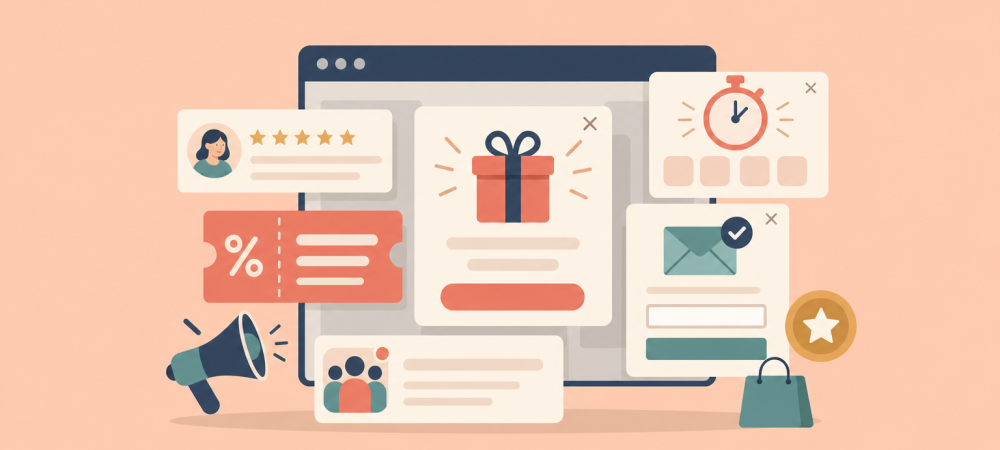
Popups have a bad reputation, but the format is not the problem — thoughtless use is. Done well, a popup appears at the right moment, makes a clear offer, and feels like help rather than an interruption. Here are 20 popup examples that convert, grouped by goal, with the trigger and offer behind each so you can adapt them to your own store.
1. What makes a popup convert
One principle ties the whole list together: a popup should feel earned by the visitor’s behaviour, not imposed on it. The best ones read the signals a person is already sending — lingering on a page, scrolling deep, moving to leave, returning for a second visit — and respond with an offer that suits that exact moment. When a popup matches intent like that, it stops feeling like an ad interrupting the page and starts feeling like a helpful shop assistant appearing at precisely the right time. Keep that test in mind as you borrow from the examples below: does this fire because the visitor is ready, or just because they arrived?
Every effective popup gets three things right: the trigger (when it appears), the offer (what it gives), and the targeting (who sees it). Get the timing wrong and even a great offer annoys people; get the offer wrong and perfect timing wins you nothing.
As you read the examples below, notice that the winning ones never fire the instant someone lands. They wait for a signal of intent — time on page, scroll depth, exit intent, or a specific page — and then make an offer that fits where the visitor is in their journey. That combination is what separates a popup people thank you for from one they reflexively close.
2. Email capture popup examples
- The first-order discount. After a visitor has browsed for 15 seconds, a popup offers 10% off their first order in exchange for an email. The small delay filters out instant bouncers, and the discount gives a concrete reason to subscribe rather than a vague “join our newsletter.”
- The content upgrade. On a blog post, a popup triggered at 50% scroll offers a related checklist or guide as a download. Because it appears only to engaged readers and matches what they are reading, it converts far better than a site-wide signup box.
- The back-in-stock alert. On a sold-out product, a popup invites visitors to leave an email to be notified when it returns. It captures demand that would otherwise walk away and doubles as proof the item is popular.
- The spin-to-win email gate. A gamified wheel asks for an email for a chance at a prize or discount. The playful format lifts signup rates because entering feels like fun rather than a transaction.
3. Discount and coupon popup examples
- The exit-intent coupon. As the cursor moves toward the back button, a popup offers a modest discount to complete the purchase. Because it targets people who are leaving anyway, it recovers sales without handing a discount to shoppers already heading to checkout.
- The cart-threshold nudge. When a cart sits just below a free-shipping or discount threshold, a popup points out how little more is needed to unlock it. It raises average order value by framing the gap as an easy win.
- The returning-visitor welcome-back. A popup shown only to people on their second or third visit offers a small incentive to finally buy. It rewards genuine interest rather than bribing first-time browsers.
- The timed flash offer. On a sale page, a popup presents a code that is valid for the next 15 minutes, with a visible countdown. The real deadline turns browsing into a decision.
4. Urgency and FOMO popup examples
- The low-stock alert. A popup on a product page notes that only a few units remain, when that is genuinely true. It reframes hesitation as a risk of missing out entirely.
- The sale countdown. A popup announces that a promotion ends tonight, with a ticking timer. It works because the deadline is real and specific rather than a permanent “limited time” banner.
- The shipping cutoff. “Order in the next 2 hours for delivery by Friday” appears on product and cart pages. It converts browsers who want the item by a certain date by making the cost of waiting concrete.
- The seasonal deadline. Ahead of a holiday, a popup counts down to the last order date for guaranteed arrival. It turns a vague intention to shop into a dated task.
5. Social proof and exit-intent popup examples
- The recent-sales notification. A small corner popup announces that “someone in Amsterdam just bought this,” drawn from real orders. It makes invisible demand visible and reassures the next shopper that others are buying.
- The live visitor count. A badge showing how many people are viewing an item right now creates a real-time crowd and a gentle sense of demand.
- The review highlight. An exit-intent popup surfaces a strong, genuine customer review as a last reassurance before the visitor leaves. It answers lingering doubt with another person’s experience.
- The milestone popup. “Join 25,000 happy customers” appears as a confidence boost near the decision point, anchoring the shopper to the size of the crowd that already trusts you.
6. Gamified and welcome popup examples
- The spin-to-win wheel. A prize wheel offers discounts or small gifts in exchange for an email. The interactivity lifts both signups and the sense of a reward earned rather than given.
- The welcome popup for new visitors. Shown after a short delay to first-time visitors only, it introduces your best offer or bestseller without interrupting the page load.
- The quiz or finder. A popup invites shoppers to answer a couple of questions to find the right product. It both helps the visitor and captures useful preferences and an email.
- The mystery-offer reveal. A popup teases a hidden discount revealed only after the visitor enters an email. Curiosity drives the signup, and the reveal delivers a genuine deal.
7. How to build your own
A word on restraint first: more popups is not more conversions. Each one you add competes for the same attention, and a visitor hit by three in a single session learns to dismiss all of them on reflex. Pick the smallest set that covers your real goals — typically one to capture emails, one to recover leaving visitors, and one layer of genuine social proof — and make each of those excellent rather than spreading your effort across a dozen mediocre ones. The stores that win with popups are almost always running fewer, better-timed, more honest ones than their competitors.
You do not need all twenty — you need the two or three that fit your goals, set up with the right triggers. Start by matching a popup to a job: capture emails with a delayed or scroll-triggered offer, recover leaving visitors with an exit-intent coupon, and build confidence with genuine social proof near the buy button. Then set a sensible frequency cap so no one sees the same popup repeatedly, and test your timing against your conversion rate.
Proofly lets you build many of these — email and coupon popups, countdown and urgency widgets, recent-sales notifications, live visitor counts, and spin-to-win — with targeting by page, device, and trigger so each one fires at the right moment. Used with real offers and honest proof, well-timed popups can lift conversions by up to around 15% without ever annoying the people you most want to keep.
Use FOMO on your website!
Install Proofly in a few clicks to take advantage of FOMO on your website today! No creditcard required.
Get started now!Always be up-to-date with Proofly.
The amount of people using your website on mobile devices rapidly increases. Make sure your websites are fully responsive!
59.171%
Mobile devices
This might be useful for you too:
A/B Testing for Beginners: What to Test First
Most website changes are made on gut feeling — someone thinks a new headline or button colour will help, so they change it and hope. A/B testing replaces that guesswork with evidence. By showing two versions...
2024-01-05
Read more
Little-Known Marketing Tips That Actually Work
There is no shortage of marketing advice, but a lot of it is the same familiar list repeated. The tactics below are the quieter ones — less talked about, often overlooked, yet genuinely effective. If your mark...
2021-11-01
Read more
BigCommerce Conversion Tips: How to Sell More
Driving traffic to a BigCommerce store is only half the job; turning that traffic into orders is where growth really happens. Conversion optimisation — improving the share of visitors who buy — is often...
2024-06-15
Read more
Ready to use social-proof too?
You can use Proofly within 5 minutes on your own website absolutely free!
Set-up in 5 minutes Over 25,000 satisfied customers No monthly subscription
4.7/5 customer satisfaction
Get started now!
a few thousand others...